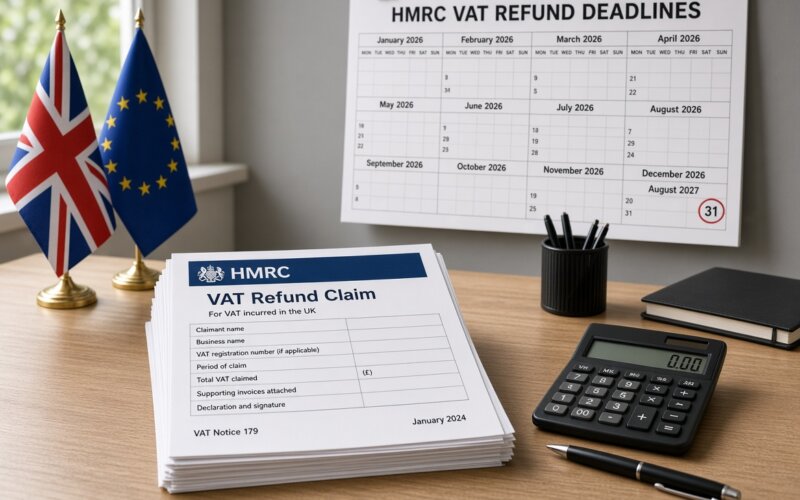

If your business paid VAT in another EU Member State during 2025 and has not yet filed a refund claim, you have until 30 September 2026. After that date the money is not delayed. It is gone.
That distinction is the whole point of this article. Article 15(1) of Directive 2008/9/EC requires that a refund application be submitted to the Member State of establishment “at the latest on 30 September of the calendar year following the refund period.” Tax authorities and courts treat this as a preclusive deadline, a forfeiture of the substantive right, not a procedural target that can be excused with a good reason.
We see the consequence every October. A finance team discovers a folder of German hotel invoices and Italian conference costs from the previous year, and there is nothing anyone can do about it.
Who this applies to
The 8th Directive procedure covers businesses established in one EU Member State reclaiming VAT charged in another. If you are established outside the EU, this is not your route. You claim under the 13th Directive instead, which has different deadlines per country, different minimums, and in several states a reciprocity test that decides whether you can claim at all. We cover that separately in our guide to VAT recovery for non-EU businesses.
The typical 8th Directive claim comes from four kinds of spend:
- Business travel: hotels, restaurants, car hire, fuel, taxis, rail
- Conferences and events: delegate fees, stand rental, exhibition costs
- Supplier invoices: services and goods invoiced with foreign VAT
- Import VAT paid at a border in another Member State
The mechanic most people get wrong
You do not file with the country that charged the VAT. You file through your own country’s tax portal, which validates that you are a taxable person and then forwards the application to the Member State of refund.
This trips up businesses that go looking for the German or Spanish portal and lose days to it. It also means your own tax authority’s portal availability is on the critical path in the final week of September, which is not a comfortable place to be.
Get the acknowledgement of receipt, and keep it
Article 15(2) requires the Member State of establishment to send an electronic acknowledgement of receipt “without delay.”
That acknowledgement is the single most important document in the process. It is your proof that you filed inside the window. If anything later goes wrong in transmission, in forwarding, or in the receiving authority’s systems, the acknowledgement is what you argue from.
This is not theoretical. In Harry et Associés Sarl (C-527/24, 12 March 2026), a French company submitted a claim for EUR 98,740.93 of Italian VAT. The application was received, but the electronic file was corrupted by technical faults outside the company’s control. The Italian courts held that the application had never existed, which denied both the refund and any route to challenge the refusal.
The Court of Justice disagreed. EU law precludes national legislation that denies both the refund and access to a court purely because of technical transmission faults in an application that was properly received. The authority has to tell the applicant about the defect and let them resubmit.
The claimant only got there because the claim was demonstrably submitted on time. Save the acknowledgement.
Thresholds that decide whether it is worth filing
| Rule | Threshold | Source |
|---|---|---|
| Minimum claim, period of at least three months but less than a calendar year | EUR 400 | Article 17 |
| Minimum claim, a calendar year or the remainder of one | EUR 50 | Article 17 |
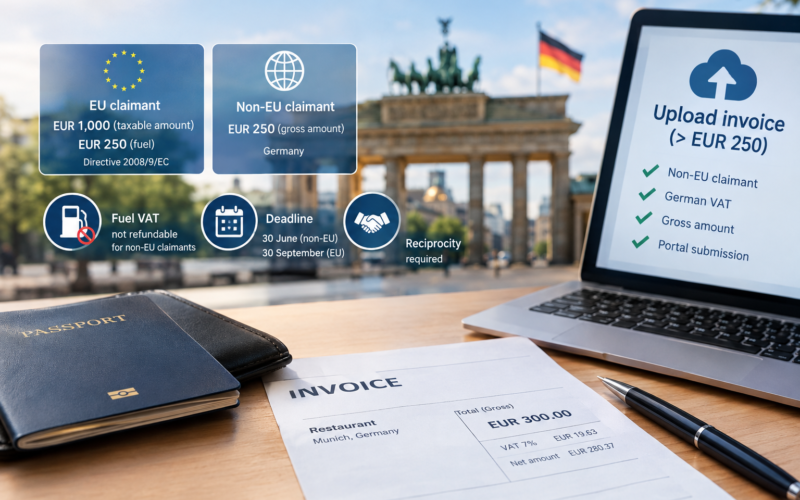
| Invoice copies may be required where the taxable amount on an invoice is | EUR 1,000 | Article 10 |
| The same threshold where the invoice concerns fuel | EUR 250 | Article 10 |
Read Article 17 carefully, because the two thresholds are often quoted wrongly. The EUR 400 figure applies to a period of at least three months that is less than a calendar year. A full year is not a EUR 400 claim, it is a EUR 50 claim. Quarterly filers face the higher bar, annual filers the lower one.
Two things follow. First, the EUR 50 annual minimum is low, so small accumulations across a year are usually worth claiming. Second, the fuel threshold is a quarter of the general one, and it is measured on the taxable amount rather than the gross, so fuel receipts need better record keeping than most travel spend. Fuel is exactly the category where receipts go missing.
What you can actually reclaim varies by country, badly
The Member State of refund applies its own deduction rules. That is where most claims lose value, and it is not intuitive: the same hotel bill can be fully recoverable in one country, partially restricted in another, and blocked outright in a third.
Restaurant and hospitality treatment in particular moved during 2026. Germany made the reduced 7% rate for restaurant and catering services permanent from 1 January 2026, and Ireland cut restaurant and catering from 13.5% to 9% from 1 July 2026, though the Irish cut does not extend to hotel accommodation. Rates on your 2025 invoices are the rates that applied then, but the direction of travel matters for how you budget the 2026 claim.
VATcube maintains a VAT Chart covering 36 countries across 15 expense categories, marking each combination as refundable, refundable at a reduced rate, refundable with restrictions, or exempt. We keep two further aviation charts for EU and non-EU based operators covering ground handling, fuel, Eurocontrol charges, repairs, hotels and car rentals, plus a restrictions table and average processing times per country. You can request the current set from our VAT chart and resources page.
How long you will wait
Once filed, Article 19 gives the Member State of refund four months from receipt to approve or refuse. If it asks for additional information, Article 21 extends that to two months from receiving the answer, but never less than six months from receipt. If it asks for further information after that, the outer limit is eight months.
So a claim filed on 30 September 2026 may legitimately not be decided until late May 2027. Plan the cash flow accordingly, and do not treat silence at month five as a problem in itself.
The clock that does matter is the one running the other way. Under Article 20(2), when the Member State of refund asks for additional information, you have one month from the date the request reaches you. That request commonly arrives in the language of the refunding state, addressed to whoever was named on the application. A month is not long to locate documents from the previous year, and a missed window is how an otherwise good claim quietly dies.
Where these claims lose money
Most claims that fail do not fail on the deadline. They fail on detail, and the pattern is consistent across the files we take over from other providers and from in-house teams.
Costs go in that the Member State of refund was never going to allow, which can taint the credibility of the rest of the application. Categories get coded to the wrong treatment, because the same expense is fully recoverable in one country, capped in the next, and blocked in a third. Invoices fail the receiving authority’s formal requirements, which are stricter than most finance teams expect and are not identical from one country to another. Requests for additional information arrive in the local language with short response windows, and a missed window closes the claim. And claims sit unresolved for months because nobody is tracking the statutory decision dates against the authority that owes an answer.
None of that is visible from the invoices. It is visible from having filed the same claim in the same jurisdiction many times before.
If your 2025 VAT is still unclaimed
You have until 30 September. VATcube files in 36 jurisdictions on a no win, no fee basis, which means we carry the work and the risk of a rejected claim rather than you.
Send us what you have and we will tell you what is recoverable before you commit to anything. If the answer is that the amounts are too small to bother with, we will tell you that too. Start at our contact page, and please do it this week rather than in the last few days of the month.
This article is general information about VAT rules and procedure as at the date of publication. It is not tax advice and should not be relied on for a specific claim. VAT rules change frequently and vary by jurisdiction. Contact VATcube for advice on your circumstances.
Request a VAT Review
Take the 1st step towards maximising VAT refunds.