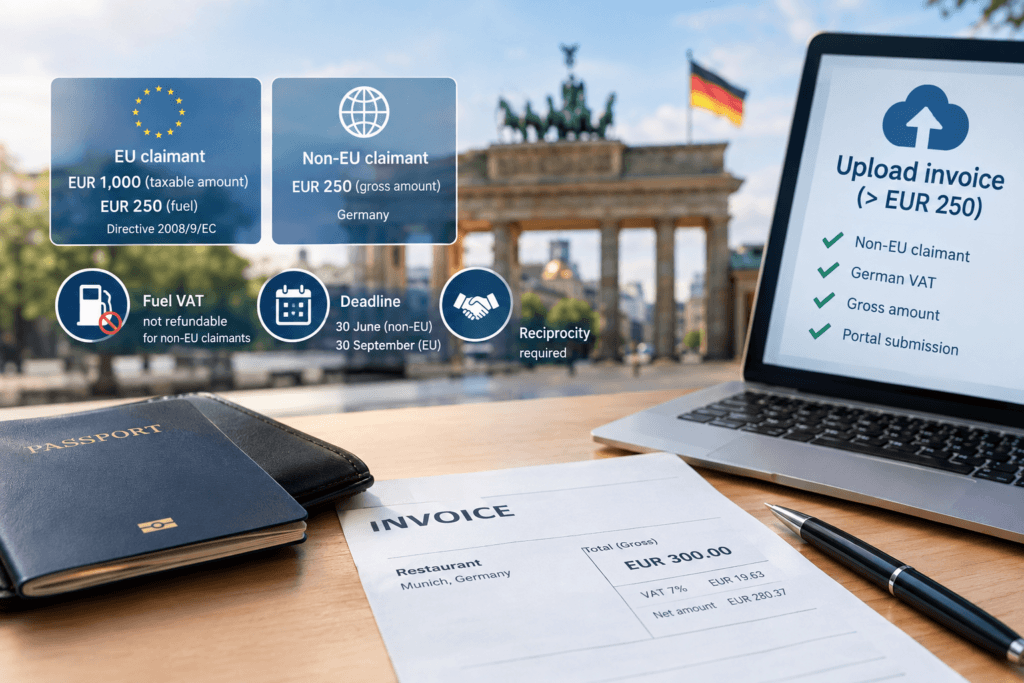
Since 1 January 2026, a business established outside the EU that reclaims German input VAT has to upload the invoice itself whenever the total on that document exceeds EUR 250. The Bundeszentralamt für Steuern (BZSt) hangs the trigger on the Gesamtbetrag, the full invoice total including VAT, and not on the net amount.
One word, and the shape of a German claim file changes for every non-EU claimant. The figure only makes sense against the rule it diverged from.
The same German VAT, two different evidence rules
An EU-established business reclaiming German VAT does so under Directive 2008/9/EC. Article 10 lets the Member State of refund ask for an electronic copy of an invoice where the taxable amount is EUR 1,000 or more, or EUR 250 or more for fuel. Germany takes that option and states it in those terms: scanned originals go across where the Entgelt, the consideration excluding VAT, reaches EUR 1,000, with the threshold falling to EUR 250 for fuel.
For the non-EU claimant the test is gross and the figure is EUR 250 for everything. Take a EUR 300 restaurant bill in Munich. German restaurant meals have been at 7% since 1 January 2026, so the net figure is a little over EUR 280. For a claimant established in France, that invoice sits nowhere near the document threshold and never has to leave the accounting system. For a claimant established in the United States, it is over EUR 250 gross and goes into the portal. A week of client dinners and a trade fair produces almost no documents in the first case and a complete set in the second.
The consequence is not the uploading. It is that a document nobody expected to produce eleven months later now has to exist, be legible, and be addressed to the right legal person.
Fuel is not a threshold question, it is a bar
BZSt states the position for non-EU claimants in a single sentence: “Die in Rechnungen über Kraftstoffe ausgewiesene Umsatzsteuer wird nicht vergütet.” VAT shown on fuel invoices is not refunded. Not reduced, not restricted, not refunded.
Set that against the EU claimant, whose German fuel VAT is recoverable and simply carries the lower EUR 250 evidence threshold. Same pump, same receipt, same German VAT, opposite answers, decided by nothing except where the claimant is established. Ground-transport spend a European group recovers routinely is dead cost to a US or Asian one, and that is better known before the budget is built than after the rejection.
Higher minimums, and a deadline three months earlier
The minimum claim for a non-EU business is EUR 1,000 where the refund period is shorter than a calendar year, and EUR 500 where the period is the calendar year or its last part. The comparable figures under Directive 2008/9/EC are EUR 400 and EUR 50. Both regimes keep the same structure, in that the shorter period carries the higher threshold, but a non-EU claimant needs roughly ten times the German VAT before an annual claim is admissible at all.
The deadline moves too. BZSt requires the application within six months of the end of the calendar year in which the VAT arose, so 30 June. Article 15(1) of Directive 2008/9/EC gives EU claimants until 30 September of the following year. Three months apart, same country, same hotel. And because the German refund period is the calendar year, VAT that misses the June date has no later application to travel in.
Reciprocity decides whether any of this matters
None of it applies unless the reciprocity condition in section 18(9) of the Umsatzsteuergesetz is met. BZSt puts it as a condition of eligibility: the state in which the business is established must refund VAT to German businesses, or levy no VAT at all. The list sits in a Federal Ministry of Finance letter of 9 November 2022 and includes the United States.
That list is worth reading rather than remembering. Entries carry qualifications, and the counts quoted second hand for how many countries sit on it do not survive contact with the document, which is why we do not publish one. The condition attaches to the state where the claimant is established, not where the group is managed or listed. A US parent whose European travel is contracted and invoiced through an entity outside the list does not inherit the parent’s reciprocity, and that is a quiet, expensive way to lose an otherwise clean claim. For the picture across the countries you actually spend in, our VAT Chart sets out recoverability by expense category, and the restrictions table covers the exclusions behind it.
Where German claims actually fail
Rarely on the portal. The recurring patterns are duller and harder to fix after the fact. A registration certificate from the home tax authority that does not cover the whole refund period, or that names a different legal entity from the one on the invoices. Hotel folios and booking confirmations filed in place of VAT invoices. Invoices addressed to the traveller rather than the company. Supplier documents missing the German VAT identification number. And the point most claimants miss entirely, that BZSt retains the power to require the original invoices and import documents on top of what has already been uploaded, so the paper cannot be scanned and discarded.
Each of those is fixable while the supplier still remembers the transaction. None of them is fixable in June 2027.
What this means in September
The German window for 2025 VAT closed on 30 June 2026. The file now being built is 2026 VAT, due by 30 June 2027, and the invoices that will populate it are being issued this month at conferences, hotels and handling agents across Germany. The evidence rule that will be applied to them is the one that changed on 1 January, not the one in the guidance most finance teams last read.
The hard part of a German non-EU claim is not the filing. It is knowing, at the moment the expense is incurred, whether it is recoverable, whether the document in hand will stand up, and whether the entity named on it is the entity with reciprocity. That judgement is the work, and it is what VATcube does across more than 25 countries on a no win, no fee basis. If you have German spend from 2026 and are not certain the paperwork behind it holds, that is a conversation for now rather than next June.
This article is general information about VAT rules and procedure as at the date of publication. It is not tax advice and should not be relied on for a specific claim. VAT rules change frequently and vary by jurisdiction. Contact VATcube for a Free VAT Assessment on your circumstances.