
The deadline in Article 15(1) of Directive 2008/9/EC passed yesterday. Applications for VAT incurred during 2025 had to reach the Member State of establishment by 30 September 2026, and the right is lost rather than postponed if they did not. The portal confirmed receipt, the file was closed, and the assumption from here is that a decision follows within four months. It does not, and the reasons sit in the Directive itself rather than in national practice.
There are two receipts, and only one of them starts a clock
Article 15(2) obliges the Member State of establishment to send an electronic confirmation of receipt without delay. That document is the proof of timely filing and it is the one worth keeping. It does not start the decision clock.
The clock in Article 19(2) runs from receipt by the Member State of refund, which is a different authority on a different date. Between the two sits Article 48(1) of Council Regulation (EU) No 904/2010, which gives the Member State of establishment 15 calendar days from receipt to forward the application by electronic means to the competent authorities of each Member State of refund concerned. Article 19(1) then requires the Member State of refund to notify the applicant, without delay and by electronic means, of the date on which it received the application.
The date that matters is therefore announced in a second notification, from a second authority, after a transfer the claimant never sees. A claim submitted on 30 September may be received by the refund state in October. Four months from receipt is not four months from submission.
Article 18 makes that forwarding step more than a formality. It lists circumstances in which the Member State of establishment must not forward the application at all, including where the applicant made only supplies exempt without deductibility during the refund period, or was covered by the small enterprise exemption. Under Article 18(2) the claimant receives an electronic notification and nothing else. A claim can end in the claimant’s own country, on grounds decided by the claimant’s own tax office, without the refund state ever opening the file.
Four months is the shortest version of the timetable
Article 19(2) requires a decision within four months of receipt. Article 20(1) lets the Member State of refund interrupt that by requesting additional information by electronic means within the same four-month period, in particular from the applicant or from the authorities of the Member State of establishment, and to request further additional information where necessary. Where there are reasonable doubts about a claim, Article 20(1) also lets it demand the original invoice or import document, which is the one route by which the Article 10 thresholds stop applying.
Once a request has been made, Article 21 replaces the four months with a different structure. The decision falls due within two months of receiving the information, or within two months of the Article 20(2) period expiring where no reply arrives, but the period available is in no case less than six months from receipt by the Member State of refund. Where further additional information is requested, the outer limit becomes eight months from receipt.
The six months is the figure most often misread. It is not a deadline. It is the earliest date a decision can be due once an information request has been issued. A question asked in week three of a claim does not produce an answer in week eleven. It produces one no sooner than month six, and lawfully so.
The only clock that runs against the claimant
Article 20(2) gives the applicant one month to provide the information requested, running from the date on which the request reaches the person to whom it is addressed. That is delivery, not reading. The request arrives electronically, frequently in a portal mailbox belonging to whoever registered the credentials rather than to whoever is managing the claim, and the month runs whether or not anyone opens it.
Missing it does not halt the file. Article 21 simply lets the authority decide two months after the Article 20(2) period expires, on the material it already holds. An application that has prompted a question and received no answer is an application that will usually be refused, because the question was asked for a reason.
Interest exists, and there are two clean ways to lose it
Article 22(1) requires an approved refund to be paid at the latest within 10 working days of expiry of the Article 19(2) deadline, or of the Article 21 deadlines where information was requested. Article 26 entitles the applicant to interest where payment is made after that date, and Article 27 runs that interest from the day following the last day for payment until the day of actual payment, at the rate the Member State of refund applies to refunds made to its own established taxable persons. Where national law sets no such rate, the rate is the one applied to late payment of VAT by the taxable person.
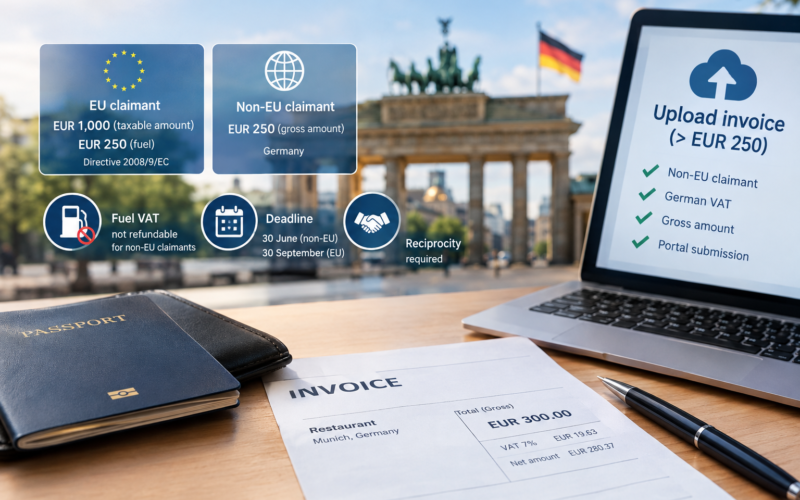
Article 26 then withdraws the entitlement in two situations. The first is where the applicant did not submit the additional or further additional information within the Article 20(2) time limits. The second is that interest does not begin to run at all until the documents required to be submitted electronically under Article 10 have been received by the Member State of refund, meaning the invoice copies that state may require where the taxable amount on the invoice or import document is EUR 1,000 or more, or EUR 250 or more for fuel.
So a claimant who answers an Article 20 request two weeks late may still be paid in full, and will be paid without interest however long the authority then takes. The cost of the delay is not the delay. It is the loss of the only financial remedy in the Directive.
When the file arrives and cannot be opened
In Harry et Associés (C-527/24), decided by the Ninth Chamber of the Court of Justice on 12 March 2026, a refund application reached the Italian authorities as an electronic file they were unable to read. The authority proceeded on the basis that no application had been submitted, leaving the claimant outside both the refund and any judicial remedy.
The Court held that EU law, read with the principles of neutrality, proportionality and good administration, precludes national rules that deprive a taxable person of both the refund and access to a court where a technical transmission fault not attributable to that person renders the application unreadable. At paragraph 51 it said the authority must inform the taxable person of the fault preventing it from opening the file and request a new, fully functional one. At paragraph 52 it held that treating the application as never made would deprive Article 20(1) of its effectiveness.
Set against the timetable above, the judgment is about who carries the cost of silence. A claim that produces no acknowledgement, no information request and no decision is not necessarily a claim sitting in a queue, and the Directive gives the claimant no automatic signal that tells the two apart.
Article 23 is the formal answer to silence. Article 23(1) requires the grounds for refusal to be notified with the decision, and Article 23(2) gives the applicant the same appeal rights, forms and time limits as a person established in that Member State, with the absence of a decision counting as a rejection that can be appealed where national law provides no equivalent remedy. The appeal then runs under the domestic procedural law of the refund state, in its language and to its time limits, none of which are set by the Directive. A claimant waiting politely for an answer that is already legally overdue may be spending an appeal window rather than a decision period.
None of this applies to non-EU claimants
Everything above belongs to Directive 2008/9/EC, which governs businesses established in an EU Member State. Businesses established outside the EU claim under the Thirteenth Directive, 86/560/EEC, and Articles 19 to 27 have no counterpart in it. The decision period, the payment period and any entitlement to interest are matters for national law in each refund state, which is also why the filing deadlines diverge: Italy, Germany, France, Croatia, Finland, the Netherlands and Austria work to 30 June, Spain to 30 September as a matter of statute, and Belgium allows five years from when the deduction arose with a maximum of one application per quarter. A non-EU claimant chasing a slow refund has no four-month clock to point at, no Article 15(2) receipt from a home authority, and no Directive-level interest entitlement to invoke.
What makes this hard
None of this is a reason to file differently. It is a reason to track differently. Whether a 2025 claim is paid during 2027 turns on the date the refund state recorded as receipt, whether an Article 20 request has gone out and into which mailbox, whether the Article 10 documents have landed, and whether that refund state treats silence as something you can appeal. Those answers sit in different places, and several change from one country to the next.
VATcube maintains a processing-times table covering statutory and typical actual turnaround by country, alongside the VAT Chart and the two Aviation VAT Charts. They exist because the timetable in the Directive and the timetable a claim actually runs on are not the same document. They are available on request from vatcube.com rather than published, because the country-level detail is the work.
VATcube recovers foreign VAT in over 25 countries across the EU plus Norway, Switzerland, the United Kingdom, Israel and Serbia, on a no win, no fee basis. If you filed before 30 September and want the clock watched properly, or you are not certain the application was forwarded at all, talk to us.
This article is general information about VAT rules and procedure as at the date of publication. It is not tax advice and should not be relied on for a specific claim. VAT rules change frequently and vary by jurisdiction. Contact VATcube for a Free VAT Assessment on your circumstances.