On 23 September 2026 the French tax administration republished BOI-ANNX-000215, the list of French airlines presumed to meet the condition for VAT exemption under Article 262, II-4° of the Code général des impôts. The list was rebuilt on 2025 traffic data. For a business aviation operator, a trip support desk or a finance team reconciling handling invoices across Europe, that quiet annual refresh decides something larger than it looks: whether there is any VAT on the invoice at all, and therefore whether there is anything to reclaim.
The question that comes before the claim
Foreign VAT recovery is usually framed as a filing problem. In aviation it is a characterisation problem first. Article 148(f) of Directive 2006/112/EC requires Member States to exempt the supply, modification, repair, maintenance, chartering and hiring of aircraft used by airlines operating for reward chiefly on international routes, together with the supply, hiring, repair and maintenance of equipment used in them. The European Commission’s own description of the exemption puts the condition as an aircraft “used by an airline whose main activity is international transport of fare-paying passengers”.
Two outcomes follow, and only one of them is a VAT recovery file. If the operator qualifies, the fuel uplift, the handling, the line maintenance and the charter are exempt at source. There is no VAT, no claim, and nothing to recover. If the operator does not qualify, VAT is charged at the domestic rate of the country where the service is supplied, and recovery runs through Directive 2008/9/EC for EU-established claimants or the 13th Directive, 86/560/EEC, for everyone else.
Corporate flight departments sit on the wrong side of that line almost by definition. An aircraft flown for the owner’s own business is not operated for reward, so Article 148 does not reach it. Those operators pay VAT on almost everything they touch in Europe, and a refund claim is the only route back. The harder cases are the commercial operators near the boundary, because the boundary is not drawn in the same place twice.
Same directive, three different tests
Article 148 says “chiefly”. It does not say how to measure it, and Member States have filled the gap differently.
France sets the bar at 80 per cent. Under Article 262, II-4° CGI the carrier’s services to or from foreign countries, or to and from the overseas collectivities and departments excluding metropolitan France, must represent at least 80 per cent of the services it operates. The measure is the unité de trafic kilomètre transporté, where one unit is 1,000 passengers or 100 tonnes of freight. Domestic flights within metropolitan France are excluded from the numerator entirely, even where they attract a separate exemption on other grounds.
Ireland sets it at a bare majority. Revenue’s own manual on services relating to vessels and aircraft states that the aircraft “must be used by a transport undertaking operating for reward chiefly on international routes”, and that “chiefly means more than 50% use on international routes”.
The United Kingdom names no percentage at all. HMRC’s transport manual treats the test as met where international flight operations exceed UK domestic operations, and accepts turnover, number of flights, seats, passengers, freight volume or distance travelled as the measure, provided the test and the result are fair, reasonable and verifiable from the records.
An operator running a mixed schedule can therefore clear the test in Dublin, clear it in London on one metric and fail it on another, and fall well short of 80 per cent in Paris. Nothing about the aircraft or the flight has changed. Only the arithmetic has.
Lists, and the ones nobody refreshes
Where the test produces a status, several Member States publish the status rather than leaving suppliers to assess it. The mechanics of those lists diverge as sharply as the tests.
Germany’s Federal Ministry of Finance publishes a list annexed to its letter of 2 January 2026 on tax-exempt aviation transactions under § 4 Nr. 2 and § 8 Abs. 2 UStG. Its title is precise about its limits: it covers operators established in Germany that predominantly conduct international commercial air transport, under § 8 Abs. 2 Nr. 1 UStG. A Maltese AOC holder, a Cayman-registered aircraft on a US operator’s certificate, or a Swiss charter company will never appear on it, and their position has to be established some other way.
France runs two lists pointing in opposite directions. BOI-ANNX-000215 names the French carriers presumed to qualify, and those carriers are relieved of giving an attestation to each supplier. The others must attest to every supplier that they meet the conditions, and the supplier has to reference that status on the invoice under Article 45 of Annexe IV to the CGI. Foreign carriers are handled by a second annex, BOI-ANNX-000216, which names the foreign airlines presumed not to qualify. That list carries its own date stamp: updated 17 December 2013, in force until a new list is published. Twelve years later it still names eight carriers, business aviation operators among them, on traffic patterns from another decade. The positive list gets rebuilt every year. The negative one has not moved since 2013.
Where it goes wrong
The failures we see cluster in a few places, and none of them are filing errors.
The supplier decides first. A fuel supplier or a handling agent has to characterise the supply when it raises the invoice, on whatever evidence it holds about the operator at that moment. Get it wrong in the exempting direction and the operator has no VAT to reclaim and a supplier who may come back for it later. Get it wrong in the taxing direction and the operator is holding VAT that was not due, which is worse than it sounds, because Directive 2008/9/EC does not apply to amounts of VAT that were incorrectly invoiced under the law of the Member State of refund. The refund procedure is closed to it. The money has to come back from the supplier, and by the time anyone notices, the supplier has often filed, closed the period, and lost interest.
Status is not portable. An operator that has an attestation accepted in one Member State routinely assumes it travels. It does not. The entitlement is determined by each state of refund on its own terms, and an exemption granted in one place says nothing about the treatment of the identical uplift two sectors later.
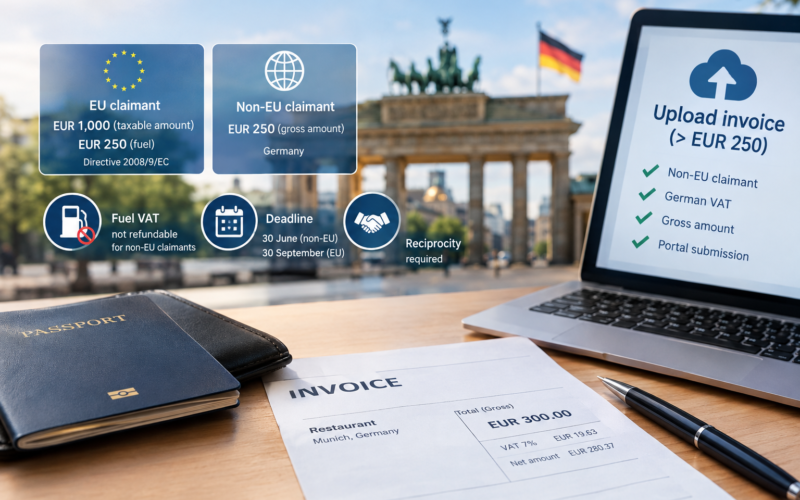
Then there are the aviation-specific holes in the refund regimes themselves, which only matter once you are in the taxed case. France excludes fuel and lubricants from recovery for non-EU claimants and requires a fiscal representative on top. Germany does not refund fuel VAT to non-EU claimants at all, which strips out the single largest line on most aviation claims before it starts. Croatia excludes aircraft purchase and lease. Directive 2008/9/EC lets the Member State of refund demand an electronic copy of the invoice where the taxable amount reaches EUR 1,000, and only EUR 250 for fuel, so an aviation claim generates evidence requests at a density no other expense profile does.
And the clocks are unforgiving. For EU-established claimants, Article 15(1) of Directive 2008/9/EC closes the 2025 refund year on 30 September, and the right is lost rather than delayed. Non-EU claimants have no harmonised deadline at all: Germany, France, Italy, the Netherlands, Austria, Finland and Croatia run to 30 June, Spain to 30 September by statute, and Belgium works on a five year window with one application per quarter. An operator with fuel in five countries is on several different calendars at once.
What this actually takes
None of this is difficult to state. It is difficult to run. It means knowing, per country, which test applies and on what measure, whether a published list governs and when it was last touched, what attestation the supplier needs before it will zero-rate, and what the refund regime does to fuel and handling once the exemption fails. It means reading a handling invoice and knowing immediately whether the VAT on it should be there.
VATcube maintains two Aviation VAT Charts for exactly this, one for EU-based corporate and commercial aviation companies and one for non-EU based operators, covering ground handling, fuel, Eurocontrol charges, repairs, hotels and car rentals country by country, alongside our main VAT Chart and our restrictions and processing times tables. They are client documents rather than published ones, because they are the work product. You can request them from VATcube.
If you are carrying VAT on European aviation costs and are not certain whether it should have been charged, that is the right question to be asking, and it is the one we answer before we file anything. Talk to us. We work on a no win, no fee basis in over 25 countries.
This article is general information about VAT rules and procedure as at the date of publication. It is not tax advice and should not be relied on for a specific claim. VAT rules change frequently and vary by jurisdiction. Contact VATcube for a Free VAT Assessment on your circumstances.