France switched on the main phase of its e-invoicing reform on 1 September 2026. From that date every business in France must be able to receive electronic invoices, and large and mid-size companies must issue them and transmit transaction and payment data to the administration. Small and micro enterprises follow on 1 September 2027. Invoices travel through a plateforme agréée, an accredited platform registered by the tax administration for a renewable three-year period, and impots.gouv.fr is blunt that a merely compatible solution without registration cannot transmit invoices or report data to the authorities.
Read that as a foreign claimant and the obvious conclusion is the wrong one. The French e-invoicing obligation does not apply to your invoice.
The mandates stop at the border
Article 289 bis of the CGI covers operations carried out between taxable persons established in France, falling within the scope of French VAT, for which French invoicing rules apply. All three conditions. A sale to a business established outside France sits instead under e-reporting, Article 290 of the CGI, where the supplier transmits transaction data to the DGFiP and the invoice itself never enters the accredited platform flow as an invoice.
Belgium has the same shape. Structured electronic invoices have been compulsory since 1 January 2026 for nearly all operations between Belgian VAT-registered businesses, and the FPS Finance states plainly that taxable persons not established in Belgium, without a fixed establishment there, fall outside the obligation.
So the German group reclaiming French hotel and conference VAT, the US operator reclaiming Belgian ground handling, the events company with venue costs in four countries, all of them are formally outside the mandate. That reads like relief. It is the opposite.
What the refund procedure still assumes
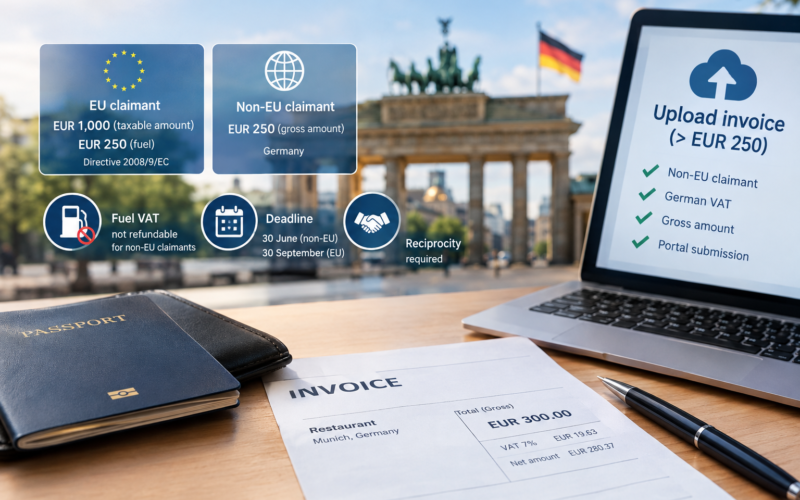
Article 10 of Directive 2008/9/EC allows the Member State of refund to require the applicant to submit, by electronic means, a copy of the invoice or importation document where the taxable amount is EUR 1,000 or more, or EUR 250 or more for fuel. Taxable amount, not the gross. Assessed per document. And it is a power the refund state may exercise, not an automatic requirement, which is exactly why practice between refund authorities diverges so widely on what has to be attached.
Article 20(1) goes further. Where the refund authority has reasonable doubt about the validity or accuracy of a claim, it may request further information and it may demand the original document. The Article 10 thresholds do not restrain it there.
Both provisions rest on a single assumption: that the claimant holds a document and can hand it over. That assumption was safe when an invoice was paper, or a PDF a supplier emailed on request. It is getting less safe every quarter, because the authoritative version of the invoice is moving into national infrastructure that a non-established claimant has no standing to enter.
The gap almost nobody has legislated for
Poland is the one regime we have seen publish a mechanism aimed squarely at a recipient outside the system. Where a Polish structured invoice is passed to someone outside KSeF, the document must carry a QR code showing the KSeF number, the unique identifier the system assigns once it accepts and processes the invoice, so that the holder can verify the document against the system that issued it. The FA(3) logical structure has been the binding template for structured invoices since 1 February 2026.
That is a real answer to a real problem. Whether a refund authority in another Member State will accept a KSeF visualisation as a compliant copy for Article 10 purposes is a separate question, and we have not seen it confirmed in writing by any of them. Most of the other mandating states have published nothing equivalent at all. The recipient outside the system is simply not addressed.
How this breaks a claim in practice
The pattern is consistent enough to be worth naming. A supplier rebuilds its entire billing stack around the domestic mandated route, because that is where the penalties are. The foreign customer becomes the residual case, served by whatever the new system spills out: a structured file with no human-readable rendering, a portal notification, or a visualisation missing fields the refund authority expects to see. The document the claimant holds and the record the tax administration holds stop being the same object, and reconciling the two becomes part of the claim rather than a formality.
Then the timing bites. Where the refund authority requests additional information under Article 20(2), the claimant has one month from the date the request reaches them. That clock keeps running while a supplier’s finance team works out how to produce a copy for a customer their platform was never designed to serve, and it does not care that the delay sits at the supplier’s end. Where the authority escalates and asks for an original under Article 20(1), the honest answer in a fully mandated state may be that no original in the traditional sense exists at all.
2030 turns a friction into a structure
It is worth being precise about ViDA, because it is widely misdescribed. Council Directive (EU) 2025/516 does not amend the refund procedure in Directive 2008/9/EC, and it does not touch the 13th Directive at all. The European Commission’s own timetable puts Digital Reporting Requirements for cross-border B2B transactions at 1 July 2030, built on e-invoicing, with the alignment of pre-existing domestic regimes running to 1 January 2035. The effect on foreign VAT recovery is indirect, and it is still substantial: the document a claim depends on is being redefined by instruments drafted with domestic compliance in mind, not with claimants in mind.
What this actually takes
The hard part of a foreign VAT claim in 2026 is no longer the arithmetic. It is knowing, per country and per supplier, which document will satisfy that refund authority, when a structured file needs converting into something a reviewer will accept, when a QR-coded visualisation will pass and when it will not, and how to get a compliant copy out of a supplier whose new billing system has no route to a non-established customer. None of that is written down in one place, because the mandates and the refund directives were drafted by different people for different purposes and have not been reconciled.
We file in over 25 countries across the EU plus Norway, Switzerland, the UK, Israel and Serbia, on a no win, no fee basis, and we track the divergence between what each mandate produces and what each refund authority will accept. Our VAT Chart sets out recoverability by expense category, country by country, alongside our restrictions table and our processing-times data. We do not publish it, because keeping it current is most of the value. If you want to know whether your French, Belgian or Polish spend is worth pursuing this year, request the chart and we will tell you.
This article is general information about VAT rules and procedure as at the date of publication. It is not tax advice and should not be relied on for a specific claim. VAT rules change frequently and vary by jurisdiction. Contact VATcube for a Free VAT Assesement on your circumstances.