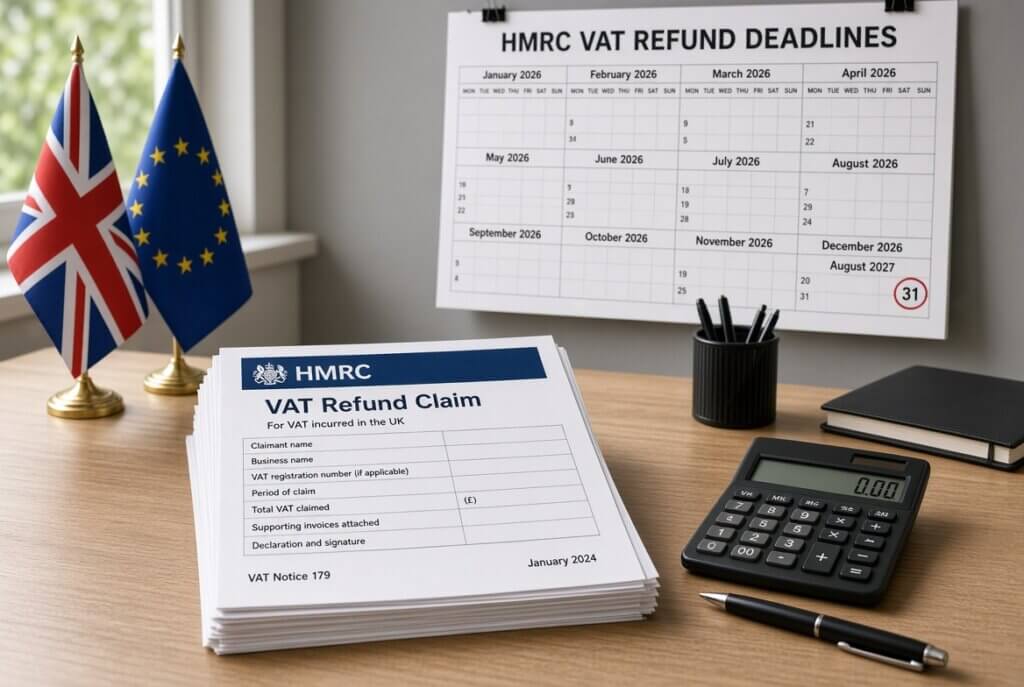
Revenue and Customs Brief 8 (2026), published by HMRC on 8 September 2026, reverses a rule that has been quietly killing refund claims since 1 January 2021. HMRC will now only accept a claim under the Overseas Refund Scheme from the non-UK business that actually incurred the VAT, and not from the representative member of its UK VAT group.
That reads like an administrative tidy-up. It is not. It decides whether a claim legally exists, and it puts five years of rejected claims back in play on a fixed clock.
What HMRC changed
From 1 January 2021, HMRC required a non-UK member of a UK VAT group to claim through the group’s representative member. Where that representative member was UK established and had incurred none of the VAT itself, the result was a claim that nobody was properly placed to make. Claims were refused on that basis. The brief now states that all non-UK businesses that are members of a VAT group must submit their own claim for any UK VAT they incur.
Two dates carry the consequence, and both are hard.
For VAT incurred between 1 July 2025 and 30 June 2026, HMRC will accept a claim from either the individual non-UK member or the representative member. The deadline is 31 December 2026. Note what that transitional window does and does not do. It removes the argument about which entity signs. It buys no extra time at all, because 31 December 2026 is already the ordinary deadline for that period.
For claims rejected since 1 January 2021 on the old basis, where the VAT was never picked up in a later representative member claim, HMRC will reconsider. Requests have to reach the Overseas Repayments Unit by 31 August 2027. That is a real recovery opportunity for any group that took a refusal and wrote the VAT off, provided the invoices still exist and the group can show which entity incurred what.
The UK runs a calendar that matches nobody
The Overseas Refund Scheme does not operate on the calendar year. VAT Notice 723A sets the prescribed year as the twelve months from 1 July to 30 June, with claims due by 31 December following the end of that year. The minimum claimable amounts are GBP 16 for a full prescribed year and GBP 130 where the period is shorter than twelve months but at least three.
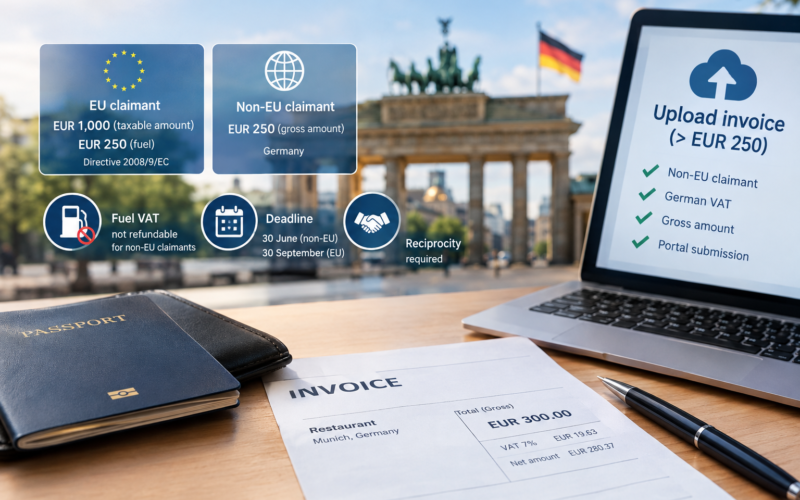
Now set that against the rest of a typical European claim programme. Article 15(1) of Directive 2008/9/EC gives EU established claimants until 30 September of the calendar year following the refund period, and that deadline is preclusive, meaning the right is lost rather than delayed. Under the 13th Directive, Germany, France, Italy, the Netherlands, Austria, Finland and Croatia all sit on 30 June. Spain sits on 30 September, and in Spain that date is statutory rather than administrative practice. Belgium allows five years from when the deduction arose, but restricts a claimant to one application per quarter.
A business with UK and EU spend is therefore running at least three unrelated clocks over periods that do not align, with different minimum thresholds attaching to each, and now with a different rule about which legal person holds the claim in the UK than applies anywhere else. Nobody diarises that correctly by accident.
Where these claims actually fail
Very few UK overseas claims fail because the expense was not recoverable. They fail earlier than that.
The commonest cause is the one HMRC has just addressed, the claim made by the wrong legal person. That is fixed prospectively, but for the years already refused the reconsideration route is the only way back, and it expires.
The second is the certificate of status. HMRC requires it to be issued by an authority it recognises, and it is valid for twelve months from issue. A certificate from the wrong body, or one that has aged out between being obtained and the claim being filed, is not a curable defect at the point the deadline passes.
The third is the restriction set itself. UK rules block business entertainment and hospitality, and allow only 50% of the VAT on the hire or lease of a car used for both business and private purposes. Those restrictions do not map onto the equivalents in France, Belgium or the Netherlands, each of which excludes and caps different things through different mechanisms. VATcube maintains the country and expense detail in its VAT Chart, which sets out recoverability by expense category country by country, alongside a separate restrictions table and a table of average processing times. It is available on request at vatcube.com rather than published, because the detail moves and a stale matrix is worse than none.
What this means before 31 December
If your group has non-UK members that incurred UK VAT in the year to 30 June 2026, the filing entity question is now settled and the deadline is 31 December 2026. If your group was refused a UK refund at any point since 1 January 2021 because the representative member was not the right claimant, there is a window to reopen it that closes on 31 August 2027, and it will not be extended.
The hard part of this work is rarely the law. It is holding several dozen deadlines, entity rules, certificate validity periods and restriction sets in the right order across a group structure, in a year when three of those countries have also changed something. That is what VATcube does, in over 25 countries across the EU plus Norway, Switzerland, the UK, Israel and Serbia, on a no win, no fee basis. If you are not sure whether your UK group claims have been filed by the right entity, or whether a refusal from 2022 is still recoverable, talk to us before December.
This article is general information about VAT rules and procedure as at the date of publication. It is not tax advice and should not be relied on for a specific claim. VAT rules change frequently and vary by jurisdiction. Contact VATcube for a Free VAT Assessment on your circumstances.